EDM Mixing and Mastering: Why Louder Can Sound Smaller
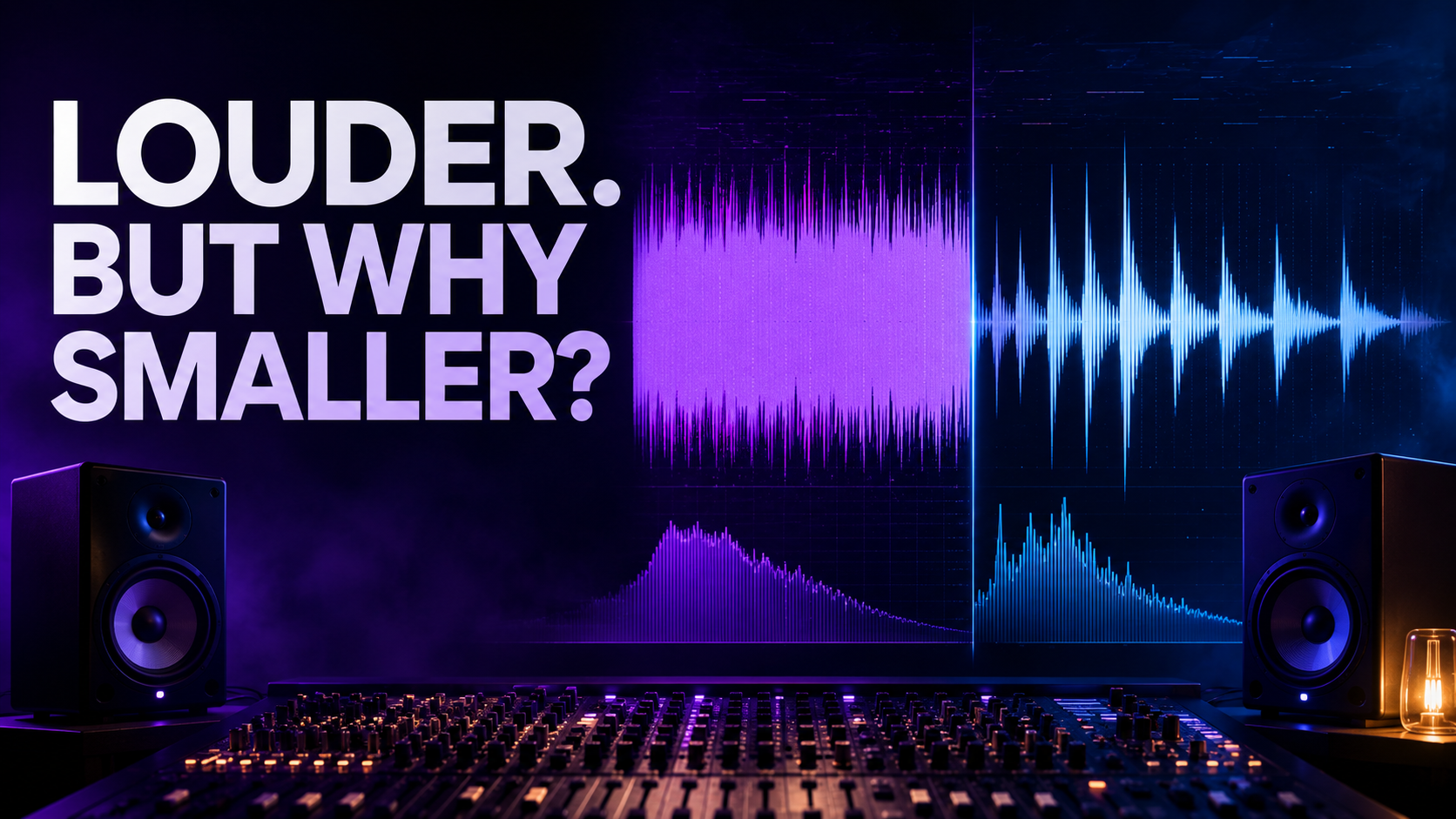
Why can an EDM master become louder on the meter but feel smaller in the drop? It is one of the most frustrating moments in music production. The limiter shows more level, the waveform looks impressive, and the track appears competitive. Then you compare it at the same listening volume with a professional release—and your version has less punch, less depth and less excitement.
The problem is not loudness itself. EDM is physical music, and density is part of its language. The problem begins when loudness is treated as a number instead of the result of good production, arrangement, mixing and mastering decisions. A strong master does not simply play loud. It stays clear, controlled and emotionally convincing when it is played loud.
Loudness and impact are not the same thing
Perceived loudness is influenced by more than an integrated LUFS reading. Frequency balance, transient shape, stereo information, arrangement density and contrast all affect how powerful a record feels. Two tracks can measure similarly while one sounds open and energetic and the other sounds flat.
Impact comes from movement. A kick feels powerful because it rises quickly out of the surrounding sound. A drop feels large because the breakdown created space before it. A vocal feels present because competing instruments leave room in the most important frequencies. If everything is constantly at maximum intensity, the listener loses the reference that makes the loud section feel loud.
This is why professional EDM mixing and mastering starts long before the final limiter. The master can enhance a strong hierarchy, but it cannot invent one when every element is fighting for the same space.
The limiter may be revealing a mix problem
When a master loses energy, the first instinct is often to change the limiter. Sometimes that helps, but the limiter may only be exposing an earlier issue. Excessive sub energy, sharp upper mids, uncontrolled percussion or too many simultaneous layers can consume headroom before the musical core has a chance to speak.
Low frequencies are especially expensive. A sub that sounds impressive in solo can trigger gain reduction across the entire mix. The result may be a softer kick, a vocal that moves backward and synth transients that lose definition. Pushing the threshold harder then makes the track denser without making it feel bigger.
A cleaner result often begins with smaller moves: shorten an unnecessary bass tail, separate kick and bass timing, remove inaudible low-frequency information from other instruments, or automate a layer out when the arrangement becomes crowded. These decisions can create more usable loudness than another decibel of limiting.
Protect the transients that define the groove
The leading edge of a kick, clap or percussion hit gives the groove its shape. If every transient is rounded off, the track may become loud but lose forward motion. This is particularly obvious after loudness matching, because the apparent advantage of the hotter master disappears while the loss of punch remains.
Transient control does not mean leaving every peak untouched. A few uncontrolled peaks can prevent a master from reaching the desired density. The goal is to decide which transients carry the rhythm and which are simply wasting headroom. Gentle clipping, compression, saturation or envelope shaping can all be useful when applied deliberately and often in stages.
I prefer to solve the biggest peak problems close to their source. If the kick needs a different shape, I change the kick. If a snare is too aggressive, I adjust the snare or its group. Asking the mastering chain to correct every individual event usually creates compromises across the entire record.
Control the low end without making it small
A club-ready EDM mix needs weight, but weight is not the same as unlimited sub level. The kick and bass must have a clear relationship in pitch, timing and envelope. If both dominate the same moment and frequency range, the master becomes unstable. If they complement each other, the low end can feel larger while using less headroom.
Monitoring matters here. Small speakers may hide deep resonances, while an untreated room can exaggerate or cancel important notes. I check low-end decisions on multiple systems and at different listening levels. At low volume, the groove and balance should still make sense. On a larger system, the sub should extend the track rather than detach from it.
This is one reason working with an experienced mixing engineer near Vienna can make a meaningful difference. The value is reliable judgment about what the track is actually doing.
Use contrast as part of the master
Arrangement is one of the most powerful loudness tools. Removing a bass layer before the drop, narrowing a breakdown, reducing reverb in a busy section or simplifying the final bar can make the next moment feel dramatically larger without increasing its measured level.
Micro-dynamics matter as well. A short fill can become more exciting when the elements around it step back. A vocal phrase can feel more expensive when effects are automated rather than left static. Even a dense festival record benefits from small changes in width, tone and level that guide attention through the song.
A mastering engineer in Austria can refine this contrast, but the strongest version is created together with the production. When arrangement, mix and master support the same emotional arc, loudness becomes a natural consequence rather than a rescue operation.
Streaming normalization does not choose your artistic target
Streaming platforms can turn loud masters down during playback. That does not mean every EDM track should be mastered to one universal number. A DJ-oriented record, a radio edit and an acoustic version have different needs. Genre expectations and the intended playback environment still matter.
The useful question is not, “What LUFS number guarantees success?” It is, “How loud can this track become before it loses the qualities that make it work?” For one production, the limit may be set by the kick. For another, it may be vocal harshness, stereo instability or an overcrowded drop.
Reference tracks help when they are level-matched and chosen for a genuinely similar style. Compare low-end weight, vocal position, transient definition and the transition into the drop—not only the meter. A reference is a compass, not a template.
A better workflow for a powerful EDM master
Before final mastering, I listen for a few essential conditions: the hook is obvious, the kick and bass relationship is stable, the vocal or lead remains clear, the drop has contrast, and no single frequency range forces the limiter to work unnecessarily hard. I also leave enough flexibility to make mix revisions after hearing what the mastering chain reveals.
Then I build loudness in controlled stages rather than demanding everything from one processor. The exact tools change from track to track. The principle does not: every stage should have a clear purpose, and each extra decibel must earn its place. If the master becomes smaller, harsher or less emotional, the right move may be backward.
The goal is not the largest waveform. It is a record that still feels powerful after normalization, survives different speakers and keeps its identity when played beside professional releases.
Looking for EDM Mixing and Mastering in Austria?
If your production is loud but still lacks depth, punch or clarity, the solution may be in the relationship between arrangement, sound selection, mixing and mastering—not in another limiter setting. Dino Mileta brings more than 20 years of experience in music production, songwriting, mixing and mastering in Austria, working with artists who want a distinctive, release-ready sound near Vienna and for international projects.
Whether you need a complete production or focused help finishing an existing track, the process begins with the music and its intended audience. If you are ready to turn your idea into a confident professional release, get in touch and start a project.